Innovative UI/UX Trends

In this digital world, where user experience is very important, staying up-to-date with the ongoing changes in UI/UX design is a requirement and not an option. The persistent technological advancement along with innovative approaches  has enhanced the bar for user expectations and offering a smooth and flawless user experience is important for business success.

Last year, some of the exciting UI/UX trends included personalization, data-driven storytelling, scroll-telling, and interfaces having buttons. Let’s explore the future of UI/UX, by probing into some of the exciting innovative approaches and technologies in the year 2024. This futuristic design principle is expected to bring a huge transformation in how we interact with digital products and services.

Geolocation technology

Location-dependent UX is rapidly gaining demand as it provides customized and useful experiences depending on the geo-locations of the user. AI plays an important role here in the prediction of user movement and behaviors for suggesting appropriate places, services, and events.

  • Instinctive suggestions: Location-dependent UX provides suggestions that align well with the lifestyle of the user such as public transportation options highly suitable for their requirements.
  • User-focused design: Apps providing location-based experiences are the front position of the user-centric designs, thereby focusing on customization and ease of use.

Integration of augmented reality and virtual reality

One of the major developments of UI/UX is the incorporation of augmented reality (AR) and virtual reality (VR). With AR, the digital information is overlaid into the realistic world, thereby increasing the perception of the user and VR dips users into a full virtual atmosphere. This will bring a revolution in how users stay engaged with the applications, offering a highly immersive experience. Starting from gaming to education and beyond that, AR and VR are going to become important components of UI/UX concepts.

Micro-interactions for increasing user engagement

Micro-interactions are underrated but powerful UI/UX design tools designed for the future. They help users by offering guidance through any digital product and increase the user experience by offering instant feedback on the actions of users. In this year, those small interactions are important for the creation of intuitive and highly engaged user interfaces.

When UI/UX designers competently knit micro-interaction and motion designs, they make experiences that are both engaging and memorable, thereby leaving a long-lasting effect on the users. It helps in making the navigation enjoyable and intuitive.

Voice UI

With the increase in the use of voice-controlled devices, there is a rise in a new era for UI/UX designs. Voice UI is becoming highly popular with many virtual assistants such as Siri, and Google Assistant paving the way. Users are now expecting flawless interactions by using natural languages and designers should adapt to develop interfaces that understand and give good responses to all spoken commands. This trend not only helps in increasing accessibility but also opens several new chances for hands-free and instinctive user experiences.

Artificial intelligence and machine learning

Artificial intelligence and machine learning are bringing transformation in UI/UX concepts by offering customized and predictive experiences. AI analyzes the user behavior to anticipate choices, thereby creating interfaces that are user-friendly and instinctive. With Chabot, it’s easy for users to get customized assistance. AI and ML make sure that UI/UX better adapts to user requirements, thereby generating a dynamic and highly responsive digital atmosphere.

Contextual UX

Contextual user experiences involve the deliverance of customization at a deep level. It is about creating designs that better understand and adapt to the immediate environment and situation of the user. For instance, a fitness application suggests doing indoor workouts on a rainy day, and a music application creates playlists depending on the time of the day. In the coming days, there will be UX designs that can analyze real-time data such as weather conditions, the location of the user, and also physical activities to offer a customized and right user experience.

Minimal and high-clarity designs

Minimal and high-clarity UI/UX designs emphasized simplicity, functionality, and clarity. Users like interfaces that are easy to navigate, visually attractive and lack unnecessary things. These innovative approaches not only increase the satisfaction of users but also ensure fast loading times and enhance performances.

3D elements in UI/UX futuristic design principles

The incorporation of 3D elements in UI/UX designs is bringing in a revolution in how various users perceive and interact with several digital platforms. 3D designs not only help add depth and realism but also increase user engagement as well as interaction in the year 2024. WebGL is a JavaScript API that is used for producing interactive 3D and 2D graphics in web browsers. It allows the development of 3D illusions, animations as well as interactive 3D objects providing users with some appealing and immersing experiences.

Neomorphism

It’s a novel UI aesthetic that creates a soft and tactile experience on the interface. In the year 2024, there will be an evolution of design trends through the inclusion of highly interactive elements. Here the light and shadow not only develop a sense of depth but also respond well to user interactions. This UI/UX trend is best for the creation of user interfaces that are natural and instinctive, thereby making interactions convenient, and less stressful, especially for long periods.

Dark mode

This is a mode that has transformed from becoming a good feature to a UI/UX design standard. This is a visually attractive option that not only decreases strain on your eye in less light conditions but also increases sophistication. With more websites and applications adapting dark mode, UI/UX designers should take into consideration the integration right from the initial stage of development making sure there is seamless and constant user experience all over the platforms.

Conclusion

The future of UI/UX concepts is one of the exciting frontier which is driven by the incorporation of advanced technologies and innovative approaches. Starting from immersive user experiences, conversational user interactions, and customized touch, designers need to stay up-to-date with those developments to create interfaces that resonate well with the user’s requirements and expectations. While navigating the UI/UX future trends, it’s important to maintain a proper balance between innovations and user-focused designs for creating a seamless digital experience.
Beyond Bits and Bytes: Human-Centric Software Solutions

Digital technologies are deeply embedded all over our day-to-day routines. The merging of cyber and physical environments has caused end users to select their technology depending on some of the non-functional metrics such as the feel, emotions, and complete satisfaction. Also, businesses are mainly driven by digital solutions. Business functioning depends on constant interaction between software solutions and humans. In addition, the consumer journey, right from shopping to buying different services to installation and getting engaged with them, is not possible without the use of the software.

That being said, an interesting question arises, what exactly do user centric software solutions do?Human-centric software solutions are more engaging, influential, and highly fulfilling experiences for the end users. In simple words, these intuitive software designs offer the best user experience. So, let’s know what makes a good user experience. Here are the following four important aspects that are the important determinants of end-user experience.

  • Good functionality: The main features, abilities, user interface as well as workflows that are available for the execution of the tasks and understanding the required outcome. The emphasis is on work that is guaranteed by the software service and the ability of the software system to implement this task with safety and reliability.
  • User experience or UX: The usability, ease of access, aesthetics, commitment, and feedback that a user experiences on interaction with the software. This involves insubstantial metrics like emotional and visual experiences from the perspective of an end user.
  • Exhibiting user experience: By properly considering user expectations, predicting user actions, and utilizing this predicted data for the deliverance of customized end-user services. Such a model is created depending on the user data, which might correspond to a diversified user base. The main aim of developing such a model is to perfectly generalize and predict user expectations that belong to various demographics.
  • Service dependence: It often involves the availability and consistency of the software service. Availability is the time for which the software product remains functional under normal situations. Reliability is the probability of the system staying functional in the available time, which also includes the disturbances of the underlying systems.

Benefits of human-centric software solutions

The whole designing process of human-centric software solutions has several benefits. One of the main benefits is that it enhances user experience which has been discussed. Other benefits include increased effectiveness and productivity. Software products can be designed for the automation of repeating tasks, streamlining processes, and decreasing the time and effort needed for the completion of tasks after properly understanding the requirements of the user.It can also play an important role in enhancing innovation and competition.Customized software solutions can be designed to offer new and unique features that offer a competitive benefit by focusing on user’s requirements.

Here are some of the other benefits of human-centric software solutions:

  • Enhances user satisfaction: End user satisfaction is one of the major benefits of human-centric software. Needs, choices, and issue points are taken into consideration. Users have a major role in the design process of the software, and they are not made to the audience. Because of this, the final software solution is a solution that meets all their expectations and is very simple to use. This has the potential to enhance user satisfaction and loyalty.
  • Cost deflation: Human-centric software solutions also help in decreasing the cost of software development. It is easy to develop a product that meets the user’s requirements and choices if they are recognized early in the process of designing. This means there is less requirement for expensive redesigns or iterations, which are time-consuming and costly.
  • Enhances usability: It is one of the major considerations in the software solution designing process. Human-centric software solutions make sure that the solution is simple to use and intuitive. This encourages new users to reduce the learning curve and make fewer errors. Enhanced usability also lessens distress and gives a boost to user satisfaction.

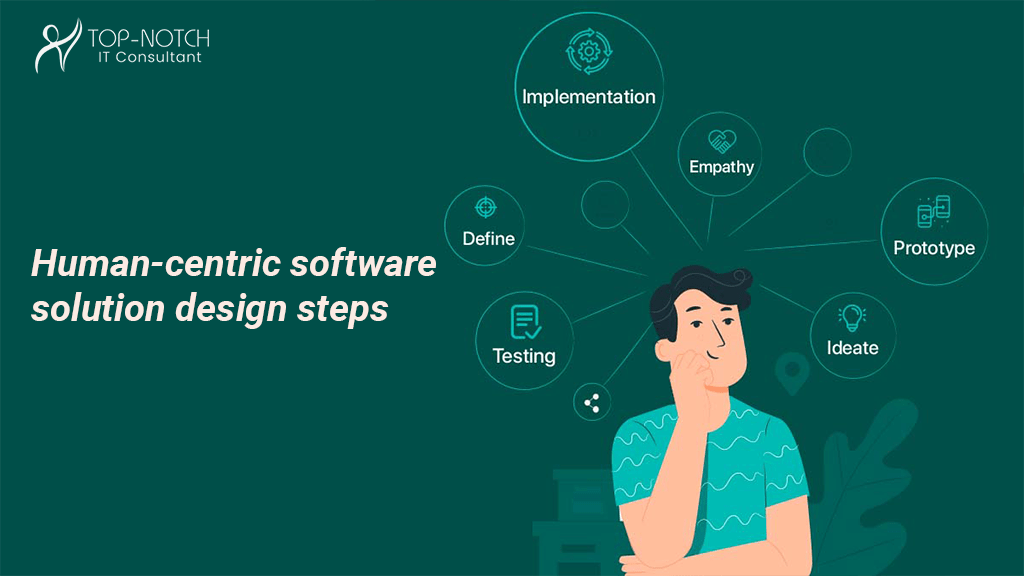
Human-centric software solution design steps

The success of any software solution relies on a flawless design structure that focuses mainly on user requirements. Human-centric software solution designing needs intuitive software designs that mainly involve a close association between the end users, stakeholders,, and developers for creating products that meet the requirements and users’ expectations.

Here are the steps involved in designing user software solutions

  • Measuring the user needs: The main step is a proper understanding of the user’s needs. This step mainly involves user research and a survey of the user data. User research can be done with the help of surveys, observations, interviews, etc. and it assists in gaining insights about the requirements, limitations, and goals the end user has for any software.
  • Creation of the persona: After the research phase, the next is making use of the insights for creating personas. These are all fictional characters that represent various kinds of users. Personas help in understanding the requirements of the users, their motivations, and behaviors and serve as a reference for any designer and developer all through the process of development. This becomes important for the developers to ideate and visualize the requirements of the client.
  • Ideation and prototyping: The third step is ideation and prototyping. Ideation includes the generation of several usable solutions for the resolution of user issues. This phase helps in scrutinizing ideas for filtering them down for the selection of the best ones. Prototyping is the development of a visual representation of any product for testing its design and operation. Prototyping helps you in the collection of input from the users, designers, and stakeholders and makes all modifications for planning before completion.
  • Testing and refining the product: For validating the design and operation of the designed digital solution, testing and refining the final product is very important. User testing is done by survey, testing of the usability, and focus groups. The results of the user tests are then utilized for fine-tuning the whole product and making all required changes before releasing it. This can be iterative and includes the active participation of every person in refining the end product that will finally meet all customer needs.

Conclusion

To conclude, human-centric software solutions are customized software solutions that are essential components of software development. It assists in the creation of intuitive and user-friendly software products and meets all specific requirements of various groups other than focusing on their requirements, limitations, and wants. User-centric software solutions demand strong cooperation among the designers, stakeholders as well as developers. Experts at any good software development company make use of user-centric software designs in their services to help you in overcoming all challenges.

Tech Harmony: Nurturing Digital Wellness

We are living in an era which is dominated by several digital developments. Therefore, it is important to have the right connection with the technologies for overall wellness. The term “digital wellness” involves practices and ways for fostering harmonic relationships with technology. This makes sure that technology increases, not diminishes our lives.

Digital wellness is the use of technology to support mental, physical, and emotional wellness rather than damaging it. To minimize the negative effects of more screen time, consistent connectivity, and data overload, it is required to take deliberate decisions and actions.

To navigate the digital landscape, you should have a strong understanding of both the advantages and disadvantages of interconnected lives. The inescapable nature of technology has given a new shape to the societal fabric thereby putting influence on not only how we are communicating but also mental health and wellness.Exploring how to use technology mindfully needs deep insights into plans for the maintenance of mental health in the digital age for maintaining tech harmony. Other than that digital wellness needs support from psychologists, digital detoxing, and looking into inventive tools.

How digital technology is impacting psychology?

Digitalization has its own set of psychological difficulties. Availability of information, desire to always stay on, and consistent comparison with others on social media lead to chronic stress that affects mental health. The culture of comparison nurtured by various social media platforms highly impacts the self-esteem and mental health of an individual, resulting in issues such as anxiety and stress.

In addition, the digital world has also developed a new phenomenon called cyberbullying and cyber harassment that contributes to several mental health problems among susceptible populations. The privacy and the distance that the digital world provides can bring in the worst human behavior, resulting in negative communications affecting the mental health of an individual.

Let’s learn how to cultivate tech harmony by nurturing healthy tech habits

Set up boundaries

It’s important to create boundaries around the use of technology for the maintenance of the right mental health. Psychologists give recommendations of specified times at the time of the day for checking social media and emails, thereby limiting the activity to some times in a day. This assists in reducing the urge to constantly check for updates, facilitating more time for offline activities that support overall wellness.

Raise a supportive online community

The communities we remain engaged with online can highly impact our mental health. Look for and contribute to online spaces that are supportive and align well with your values and well-being. Staying engaged in positive interactions and developing bonds with others who have the same passion as yours can increase your sense of belonging and offer a supportive network when required.

Digital detoxing

It is highly beneficial to have periodic digital detoxing. This includes setting some time aside like a few hours each day in each week, where you will have to turn off digital devices. During this time, engage yourself in activities that you enjoy and that will connect you with other people in a relevant way like reading, spending time with nature, or catching up with friends.

Making use of technology attentively

Technology has the power to promote your mental health when it is used mindfully. Applications that encourage meditation, proper sleep, and physical activities can help in supporting your mental wellness. Stay selective about the applications that you are using and the time you are spending on them thereby focusing on those that add value to your life and screen time management.

Teach yourself and your loved ones

Awareness is one of the major steps for change. Teach yourself and your loved ones about how technology affects mental health. Having some open discussions on how to make use of technology rightly can help foster a healthy bond with digital devices.

Creating a Balanced Digital Life

A balanced digital life needs consistent effort and modification. For that, you can reduce using or eradicating them from the routine. Equally, recognize digital activities that increase your life, whether by learning, getting associated with loved ones, or supporting mental health, and give priority to relevant work in everyday routine.

Tools for enhancing digital wellness

Many tools have been designed for promoting digital wellness. For example, several smartphones are now offering features for tracking screen time on using applications. Mindfulness applications help in providing guided meditations as well as exercises for assisting in the management of anxiety and improving sleep quality.

Cultivating good social media practice

Mindfulness extends how we can interact with social media. Before you open an app, ask yourself why you are using it. Is it because of habit, boredom, or a sincere interest? Remaining mindful of our intentions can assist us in using social media persistently, decreasing tedious scrolling and those negative feelings that come with it.

Give priority to real connections

While digital connections can offer a sense of belonging, they do not have the depth and contentment of face-to-face interactions. Giving priority to real-life connections, like spending quality time with loved ones, being part of some club, or participating in community activities can increase your sense of community and belonging.

Conclusion

So, while navigating the digital age, it’s important to remain mindful of the effect that technology can have on your mental health. By taking all necessary actions, it becomes easy to adore the advantages of the technology while protecting mental wellness. Keep in mind that it is not about eradicating technology from lives but also learning how to utilize it in a way that supports overall wellness and happiness.

The Myth of One-Size-Fits-All: Why Custom Web Development Matters

In today’s digital world, all businesses need to have a strong online presence thereby enhancing the importance of web development. Your website is like your digital storefront that serves as the primary point of contact for your target audiences. However, not all websites are made equal. This is the reason why custom web development matters for unlocking your online potential eliminating the myth of one size that fits all websites.

Today’s customers search over the internet for information, services, and products and your website has an important role in their first opinion about your business. It’s like a 24/7 digital storefront of your business that anyone can access from anywhere across the world.

A well-crafted website helps in capturing attention and also in building credibility and trust. It shows your expertise and pledge to meet consumer’s needs.

Template-based websites might seem like a cost-efficient solution but they have their limitations that can hamper the growth of your business. These templates provide very few options for customization, leading to generic and measured digital experiences.

Your website must be designed in a way that it will look like your brand extension that showcases your business value. This is where a custom website plays its role as it offers you custom web solutions.

Know about custom web development

Custom web design is a customized approach that considers the specified requirements and goals of your business. It includes working in close association with professional web designers who strongly understand your brand recognition, potential audiences, and industrial landscape.

Contrasting templates, custom web development is made from scratch bringing in a unique online presence that keeps you apart from your competitors.

Reasons why custom web development matters

Custom web designing helps in elevating your brand awareness, enhances conversions, and establishes your unique online presence.

Tailors your website as per business requirements

One of the major advantages of custom web development is tailoring all aspects of your website to match your business requirements. Whether you need an ecommerce site, booking systems, or any interactive elements, a custom website provides you with unified integration.

Your website becomes one of the powerful tools that will not only showcase your products and services but also increase user experience, and drive engagement and conversions.

Fast loading time

How efficient your website is relies on how fast it is loading. When websites load slowly, it will create a negative effect on how your website is being perceived by your audience. Eliminating all kinds of performance issues from your website is assured by custom web development. To do this, take out unrequired add-ons and include only those that your website requires.

Increases user experiences and engagement

User experience is important for the success of all websites. Custom web development focuses on developing an instinctive and user-friendly interface that attracts visitors. With the attention spans of consumers shrinking, it’s important to make a strong first impression.

A customized website design allows for creating highly responsive web layouts, making sure your website looks the best and functions without any flaws on all devices. Easy navigation, high-clarity call-out buttons, and interactive features help keep the users engaged and make them explore more.

Uniqueness

A website builder template is limited because of the preset themes and capabilities available. Your website ends up having a look like other different websites that are using similar templates. Through customized websites, you can create a website that meets all your needs. A distinct website offers your company an edge in the marketplace other than representing your vision. It is one of the main justifications for choosing custom web development.

SEO benefits

Even if you have created a stunning website, it does not matter if it is not attracting visitors. This is where SEO or search engine optimization comes into play. Custom website design helps in the integration of SEO-friendly coding, fast loading speeds, and high responsiveness in mobile, which are important ranking factors for search engines.

When your website is well-optimized, it enhances your visibility in the search results and drives traffic to your website. By aligning your customized design with the best practices of SEO, you can create a strong foundation for your online success.

Brand awareness and visual attractiveness

As you know your website helps in expanding your brand identity. Thus, customized website design assures your online presence aligns well with your brand identity. It creates a unified and notable experience for your target audience.

Starting from different color schemes to typography, all visual elements are rightly selected to evoke the required emotions and vibrate well with your target market. A visually attractive and well-crafted website helps build trust, strengthen brand identity, and leave behind a strong impression on your visitors.

Measures success and return on investment

Personalized website features not only offer the best aesthetics but also required results. By keeping track of and doing an analysis of website metrics, it’s easy to measure the success of your customized design.

High conversion rates, enhanced consumer engagement, and user experience are some of the important indicators of a well-crafted website. When designed properly, a custom web design offers a good return on investment, assisting you in growing your business and beating your competition.

Boost consumer experience

Web development is important for offering a good consumer experience. Creating a user-friendly user interface element and fast page loads are required for a good user journey. Your website can have a good look but might not function well at the same time, distracting your users from their experiences.

The quality of consumer experience is diligently tied to all the website features and functionality you offer. Since all businesses function differently, the functionality also varies. You can increase your website performance by linking it with several other systems such as CRM software and inventory management systems allowing online payments.

Conclusion

In this competitive digital world, a generic business website is not sufficient for a strong online presence. Custom web development with all personalized features helps your business to attract your target audience and attain online success. By customizing your website as per your requirements, increasing user experience, and utilizing SEO advantages, you can unlock the full potential of your business in this online world.

Beyond Convenience: The Unexpected Benefits of Implementing IoT

The pioneers of industries are highly acknowledging the abundant benefits that the Internet of Things or IoT brings to businesses in every sector. As per the forecast of the business insider, the number of IoT devices being used in several industries will reach 55 billion by the year 2025.

IoT allows organizations to replace outdated manual asset-tracking systems by executing automated sensors. Those sensors help in seamless connection to the internet and incorporate centralized systems allowing real-time monitoring of the important company assets.

IoT also has a high potential for elevation of consumer satisfaction to novel heights by providing the latest functionalities and customized experiences. Businesses and IT users can make use of the IoT platform for the maintenance of their IoT ecosystem, managing devices, applying analytics, and building up new services depending on the insights of IoT. Putting it simply, IoT allows things like wind turbines, paint cars, etc to do effective communication and offers real-time updates on the status.Nowadays, Internet of Things technology is everywhere, even at places where we least expect it, starting from the healthcare sector to retail and agriculture. There are endless applications and benefits of IoT .IoT offers businesses better, innovative services such as remote healthcare and efficient fleet management.

Common use cases of IoT

IoT offers a strong foundation for building smart and connected devices that allow a proper understanding of the processing of assets and operation of the businesses and customers. The uses of IoT are flexible as all business models as well as industries can get huge benefits by taking the right approach.

Here are some of the common use cases of IoT:
  • Retailers can make use of the IoT for better ordering to prohibit waste and overstocking. They can utilize the shopper analytics for optimization of the store layouts for strong scaling and sending notifications through the app to the users near any store location.
  • The telecom department can do remote monitoring of the equipment and prediction of the maintenance for prevention of technical issues or any kind of downtime for consumers who rely on their communication services.
  • Logistics companies can keep a good track of the fleet, inventories as well as personnel to enhance efficiency and reduce the loss of goods because of late deliveries.
  • Energy-based companies can increase effectiveness and sustainability through various IoT initiatives that connect everything starting from turbines to water meters. The sensor-implanted infrastructure allows them to detect the changes in the equipment in real-time to prohibit outages, make workplaces safe and avoid rework.
  • In utilities, it becomes easy to keep track of the consumption of energy in real-time and distribute the energy or the other products wherever they are required for increasing the smart grid initiatives and decreasing outages.
  • Manufacturers can increase the process effectiveness, decrease downtime, and gain strong insights into the performance of the equipment depending on the sensor data from the equipment connected.

These use cases show how organizations can make use of IoT insights for their benefit.

Benefits of implementing IoT

Let’s have a look at some of the major unexpected benefits that businesses get by using the power of IoT:

Enhanced safety alerts

A lot of IoT devices can send automatic messages to supervisors or managers to inform them about all useful news. For instance, they can alert them, if there is any machine tampering or any unauthorized attempts to bypass the lockout processes. Because IoT helps in reporting mistakes and all important equipment failures, it becomes easy for the supervisors to get a solution rapidly.

Improved customer experience

Even if IoT has mostly influenced the back-end processes due to its new presence, recent IoT uses have overturned the way customers approach their bonding with several businesses. Front-end consumer engagement has become a priority for businesses when they better communicate with their target audiences mainly through IoT devices. Today’s customers want to interact with businesses by phone whether through chatbots, mobile-friendly websites or any application. So, businesses are making use of the novel technology and then combining it with IoT for better customer experience.

Better visibility

This is one of the strategic advantages of implementing IoT when the matter is about production. IoT connectivity helps consistent tracking of the processes as it allows enhancements that should be made on a rolling basis. Manufacturing processes along with hangtime benefit when restricted access is recognized. It allows easy adjustments for the realization of good approaches and management of production and decrease of cost of operations.

Better management of inventory

IoT allows the managing inventory to make use of the automated asset in tracking and reporting using ERP to avoid all expensive mistakes that come with functioning within obsolete inventory tracking systems. The connectivity facilitates items to get tracked and recording of data to the ERP system. This helps in the reduction of working hours for inventory management every month and also the possibility of errors.

Updated fleet management

Construction and other companies face many challenges when matter comes to fleet management such as difficulty in finding equipment, getting access to equipment information in several degenerated systems, and recognizing the status and equipment value. IoT has updated fleet management systems by incorporating systems into one single framework having data and displaying information about the scheduling of equipment, working orders, consumer rentals, and many more things.

Conclusion

Businesses are making use of the latest IoT analytics to unlock several benefits which include increased effectiveness, productivity, and cost-cutting. The implementation of IoT brings in new inventions and is redefining conventional business operating models thereby opening several opportunities for achieving success.

Book an appointment