How Blockchain is Revolutionizing IT Supply Chains and Data Integrity

With the rapid advancement of digital technologies, it has resulted in enhanced complications in IT supply chains and data management. In an era, where the safety of data and transparency are important, blockchain technology is rising as one of the transformative solutions. Initially designed as a support system for cryptocurrencies such as Bitcoin, it has now found exclusive applications in various industries, which include IT supply chains and Data Integrity with blockchain. This centralized and immutable technology is giving a new shape to how organizations are managing supply chain management and safeguarding important data.

What is blockchain technology?

Blockchain is a well-distributed ledger technology or DLT that keeps a record of the transactions in various computers safely and transparently. Some of the important characteristics of blockchain are:

  • Decentralization: Not similar to traditional databases which are under the control of a single entity, blockchain functions on a peer to peer network.
  • Immutable: When recorded, blockchain data can’t be changed or deleted.
  • Transparent: All transactions are visible to every participant present in the network, making sure there is good accountability.
  • Safety: Blockchain makes use of cryptographic methods for the protection of data from getting exposed to any unauthorized access.

All these features make blockchain one of the best solutions for addressing difficulties in IT supply chains and the integration of data.

Role of blockchain in revolutionizing IT supply chains

Increased transparency and tracking

IT supply chains are complicated and involve several stakeholders, such as manufacturers, vendors, consumers and suppliers. In traditional supply chain systems it completely depends on centralized databases, which makes them highly vulnerable to ineffectiveness, no visibility and fraud. Blockchain makes sure there is end-to-end transparency that allows stakeholders to track products, verify their authenticity and do detection of anomalies in real time.

Example: Blockchain can assist IT companies in keeping track of raw materials that are being used in the making of chips and electronic components. Through the storage of supply chain data on a blockchain, it becomes easy for organizations to do verification of the ethical sourcing of materials and prohibit counterfeit products from making an entry into the market.

Enhanced effectiveness and reduction of cost

Blockchain removes the requirement for intermediaries and decreases manual paperwork through automation processes. These self-implementing contracts are programmed to execute actions automatically when all predefined conditions are met, lessening delays and the cost of operations.

Example: During IT procurements, smart contracts can help in the automation of purchase orders, and management of inventory and payments. This helps in the reduction of human intervention, and mitigation of errors and makes sure there are fast transactions, ultimately decreasing the cost of the supply chain.

Prevention of fraud and safety

Fraud in the supply chain is one of the substantial concerns in the IT sector, with forged components and unlawful changes that lead to severe security risks. Blockchain’s immutable ledger makes sure that all transactions are recorded permanently, making it impossible to manipulate data without ant detection thus providing Data protection in IT.       

Example: Most IT firms are making use of the blockchain for the prevention of fraud in semiconductor supply chains by keeping track of the chips from production to deployment, making sure there is use of only genuine components.

Flexibility and management of risk

Disruptions such as cyberattacks, breaches in supply chains and global crises can have a high impact on the IT supply chains. The decentralized architecture of Blockchain increases resilience through the prevention of a single point of failure. As data is stored in various nodes, even when one node gets compromised, the whole system stays intact, decreasing the risk of cyber threats.

In addition, blockchain also allows proactive risk management offering real-time visibility into potential disruptions, facilitating IT firms in adapting and making some data-driven decisions swiftly.

Blockchain and data integrity management

Data integrity means accuracy, consistency and safety of data all through the lifecycle. In the IT sector, where cyber threats, data breaches and compliance needs pose difficulties, Blockchain is proving to be a game changer.

Immutable storage of data

The cryptographic mechanism of Blockchain makes sure that when data is recorded, it cannot be changed or tampered with. This is specifically useful when industries that need audit trails, safe record keeping and regulatory compliance.

Example: IT service providers make use of blockchain for maintaining logs of system updates, safety patches and software deployments. This makes sure there is compliance with the industry standards and prevention of unauthorized changes.

Safe management of identity

With increasing cyber threats, identity theft and breach of data are becoming one of the growing concerns. Blockchain allows decentralized identity management, helping users have control of their digital identities without relying on central authority.

Example: IT companies are incorporating blockchain-based authentication systems to offer safe access management. Employees and users can verify their identities by making use of blockchain-powered credentials, decreasing the risk of any unauthorized access and fraud of identity.

Protecting data breaches

Traditional centralized databases are the main targets for hackers, as a single breach can compromise sensitive data. The decentralized nature of Blockchain, substantially decreases this risk, as there are central points of failure.

Example: Healthcare IT systems are making use of blockchain for storage of the patient records safely. As every record is encrypted and stored in various nodes, it stays protected against breaches and cyberattacks.

Verification of data and trustworthiness

Manipulation of data and misinformation are two main problems in IT-driven industries. The transparency in blockchain makes sure that data stays verifiable and trustworthy, facilitating organizations in validating information without depending on third parties.

Example: IT research institutions are making use of blockchain for storing and verifying research findings, making sure that scientific data stays authentic and unchanged over time.

Difficulties in executing blockchain

Despite all the benefits, blockchain adoption in IT supply chains and data integrity face many difficulties.

  • Measurability problems: Managing a large volume of transactions usually slows down the blockchain networks.
  • Uncertainties in regulation: Governments and regulatory bodies are still required for compliance frameworks for blockchain technology.
  • Integration complications: Integration of blockchain with legacy IT systems needs substantial investment and technical expertise.
  • Consumption of energy: Some of the blockchain networks, mainly those that use proof of work, consume high resources of energy.

Conclusion

Blockchain is bringing in transformation in IT supply chains and data integrity providing increased transparency, safety and effectiveness. Through the removal of intermediaries, prevention of fraud and making sure there is immutable data storage, Blockchain is addressing important pain points in IT functioning. While difficulties are there, consistent developments in blockchain technology are making the way for a more safe and effective digital ecosystem.

As businesses continue adopting blockchain-driven solutions, the IT industry is all set to experience high levels of trust, safety and effectiveness, thereby bringing in a revolution in how supply chains and data integrity are being managed in this digital age.

The Role of QA in AI-Driven Software Development: Ensuring Accuracy and Reliability

AI-driven software depends on machine learning models and big datasets that make quality assurance an important factor in the development lifecycle. Unlike traditional software, AI systems learn from data, which means they are subjected to biases, variations and unpredictable behaviour. Making sure that the AI applications need consistent testing and validations to lessen risks and increase trustworthiness.

Some important reasons why QA in in AI-driven software development:

  • Ensures data quality: AI models highly rely on premium quality data. QA makes sure there is data accuracy, consistency and completeness.
  • Algorithm validation: Testing of AI models makes sure that they are functioning as required and do not produce any biased or flawed outcomes.
  • Performance testing: AI applications should be evaluated for speed, measurability and effectiveness to make sure there is optimal functioning and accuracy in AI testing.
  • Safety and compliance: QA assists in recognizing vulnerabilities and making sure that AI-driven applications comply with industrial standards and regulations.

Difficulties in AI QA

AI-driven software development has some QA challenges:

  • It is not predictable: dissimilar to rule-based systems, AI models can undergo evolution and start behaving differently depending on input data, thereby making the traditional test cases insufficient.
  • Bias in different data and models: When training data consists of biases, AI models might produce some skewed outcomes. QA should include bias detection and mitigation plans.
  • Difficulties of testing scenarios: AI applications interact with dynamic and unplanned data which makes exhaustive testing very difficult.
  • Explainability and transparency: AI models often work as black boxes which makes it very difficult to trace how decisions are being made. QA should make sure that there is interpretability and a good explanation.
  • Consistent learning and model drifting: AI models need consistent learning, which can result in model drift, where performance starts degrading with time. QA should execute tracking strategies for detecting and rectifying such kinds of problems.

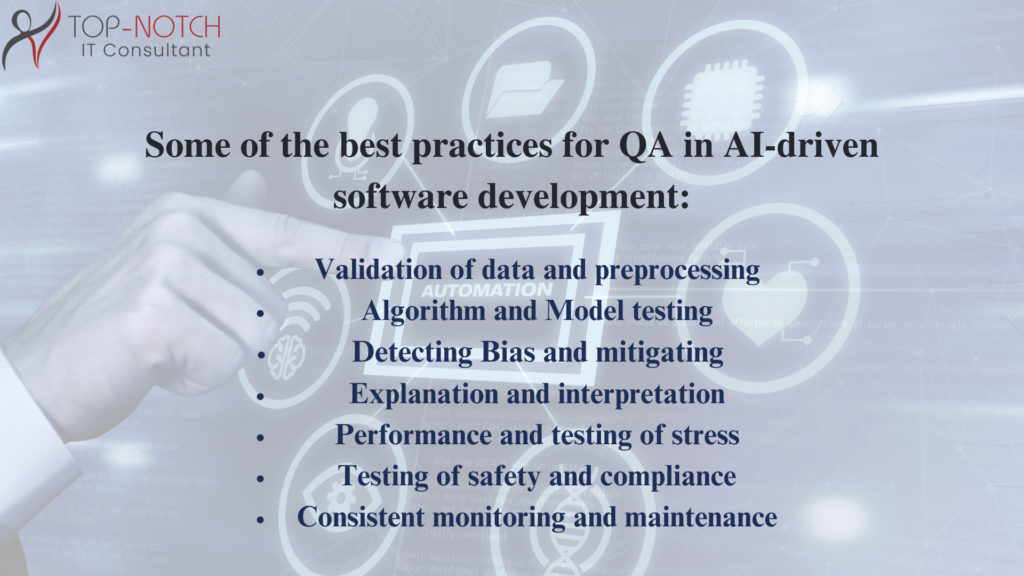
Some of the best practices for QA in AI-driven software development

To make sure there is accuracy and dependability in AI-driven software, organizations have to adopt the best possible QA practices customized as per unique requirements of AI.

Validation of data and preprocessing
  • Carrying out data cleaning for removal of inconsistencies and imprecision.
  • Use of diverse and typical datasets for lessening bias.
  • Validation of sources of data and making sure there is data integrity before feeding it into AI models.
Algorithm and Model testing
  • Performance of unit testing on specific components of models
  • Validation of AI models for utilizing various datasets to make sure there is consistency.
  • Implementation of A/B testing for comparison of model performance under several conditions.
Detecting Bias and mitigating
  • Use of fair testing tools for recognizing biases in AI models
  • Regular auditing of AI outputs for any signs of discrimination
  • Adjustment of training datasets and model parameters to make sure there is unbiased decision-making.
Explanation and interpretation
  • Using model explainability tools such as LIME or SHAP for a better understanding of AI decision-making
  • Offering documentation and reports on the functioning of AI models and making predictions
  • Making sure there is transparency in AI-driven decision-making processes.
Performance and testing of stress
  • Evaluation of AI model response times and effectiveness under several workloads
  • Conductance of load testing to make sure there is measurability and resilience
  • Monitoring real-time AI model performance and adjusting accordingly.
Testing of safety and compliance
  • Implementation of rigorous safety testing for the detection of vulnerabilities in various applications of AI
  • Making sure there is compliance with GDPR and other such kinds of regulatory standards
  • Testing for any kind of adversarial attacks and execution of safety against AI manipulation.
Consistent monitoring and maintenance
  • Establishment of real-time monitoring for tracking AI performance after deployment
  • Detection and addressing drifting of the model by retraining the models with all fresh data
  • Regular updates of AI systems for maintenance of accuracy and dependability

The future of QA in AI-driven development

With AI evolving, QA methodologies also should be adapted to it. Some of the merging trends like AI-driven testing, and the automated process of QA along with self-healing systems will play an important role in making sure that there is software reliability. The integration of AI into QA will assist in the automation of complicated test scenarios, decreasing the manual effort and increasing testing effectiveness.

In addition, the regulatory bodies are also introducing guidelines for AI ethics as well as fairness, which makes compliance testing one of the important aspects of QA. Companies who are investing in AI-driven software should give priority to developing trustworthy, ethical and highly performing AI applications.

Conclusion

The role of QA in AI-driven software development is vital. Making sure there is accuracy, dependability and transparency in testing AI systems needs a combination of data validation, consistent tracking and rigorous testing. By executing best practices in AI QA, organizations can build strong AI systems that provide relevant and trustworthy results. With AI technology advancing, QA methods will keep on evolving, strengthening the foundation of premium quality and responsible AI-driven software development.

Understanding the Environmental Impact of Cloud Computing: Strategies for Sustainable IT

Cloud computing has completely revolutionized how businesses and individuals are accessing, storing and processing data. With its measurability, effectiveness and cost efficiency, the cloud has become an important component of modern IT infrastructure. But as the adoption of the cloud grows, in the same way, the impact it has on the environment is also growing. Data centres powering cloud computing consume huge amounts of energy and make a good contribution to carbon emissions. A better understanding of the environmental effect of cloud computing and executing strategies for sustainable IT is important for a strong future.

How is cloud computing eco-impact ?

Consumption of energy

Cloud computing depends on data centres that need substantial amounts of electricity for operating servers, networking equipment and cooling systems. As per studies, data centres account for approximately 1% of the consumption of global electricity. With the rise in cloud services, this figure will keep on growing, resulting in enhanced pressure on various energy resources.

Carbon footprint

The carbon footprint of cloud computing is mainly determined by the source of energy being used for powering data centres. When the electricity is derived from fossil fuels, cloud computing makes a good contribution to greenhouse emissions. Several big cloud providers are making efforts to transition to renewable sources of energy, but still, there is a long way to go in reducing the overall carbon effect of the industry.

Use of water

Data centres need exclusive cooling mechanisms for the prevention of overheating. Most of these cooling systems depend on water-based solutions, resulting in substantial water consumption. In regions where water is scarce, these can lead to some of the major challenges in the environment.

Waste of electronics

With the rapid advancement of cloud technology, there are hardware upgrades frequently resulting in significant electronic waste. The discarded servers and networking equipment, when not disposed of properly, result in environmental pollution and depletion of resources.

Sustainable IT Strategies in cloud computing

To mitigate the environmental effects of cloud computing, individuals and organizations are adopting several sustainable strategies for a sustainable cloud infrastructure. That measure focuses on energy effectiveness, best resource management and green infrastructure.

Using renewable sources of energy

One of the most efficient ways to reduce the carbon footprint of cloud computing is by sourcing electricity from renewable energy. Companies such as Google, Amazon and Microsoft have committed to powering data centres with wind, hydro energy and solar energy. Organizations have to give priority to cloud service providers that have made substantial investments in renewable energy.

Executing energy-effective technologies

Energy-effective hardware and software play an important role in decreasing power consumption. Some of the important advancements are

  • Energy-effective processors that consume less power and maintain high performance
  • Solid state drives that make use of less energy as compared to traditional hard drives
  • AI-driven cooling systems that optimize energy use depending on real-time data of temperature.
Adoption of virtualization and server optimization

Virtualization technology allows several virtual machines to run on a single physical server, thereby maximizing resource use and decreasing the requirement for extra hardware. Organizations must focus on the optimization of server workloads, thereby closing the unused servers and consolidating the resources to enhance effectiveness.

Use of green data centres

Green data centres are made to lessen the environmental effect by making use of construction materials, energy-effective cooling systems and renewable sources of energy. Some of the vital features of green data centres are

  • Free cooling methods that use natural air or water cooling rather than energy-intensive air conditioning.
  • Effective distribution of power for decreasing loss of energy at the time of transmission.
  • Recycling and reuse of electronic components for lessening the e-waste.
Executing carbon offsetting initiatives

Organizations that can’t completely remove carbon emissions can make investments in carbon offset programs. These programs support environmental projects like reforestation, renewable energy development and carbon capture technologies. The cloud providers can also take active participation in sustainability certifications and audits to make sure that their environmental commitments are being met.

Optimization of software for energy effectiveness

Software development practices can substantially affect the consumption of energy. Developers must design applications that make use of the computational resources properly, lessen redundant processes and decrease data transmission needs. Methods like load balancing, compression of data and caching can increase the energy effectiveness.

Encouragement of responsible IT consumption

Businesses and customers must adopt responsible IT consumption habits like

  • Selecting cloud providers with the best sustainability commitments.
  • Decreasing unnecessary data storage by cleaning the redundant files and archives.
  • Making use of cloud-based collaboration tools for lessening the requirement for physical infrastructure and decreasing travel emissions.
Increasing data center cooling effectiveness

Cooling is one of the energy-intensive aspects of the operations of the data centre. Inventions in cooling technology like liquid immersion cooling and direct t-chip cooling, can substantially decrease energy and consumption of water. Organizations must explore the latest cooling solutions to increase effectiveness and sustainability.

What role do cloud providers play in maintaining sustainable IT?

Cloud service providers play an important role in bringing sustainability to IT. Several leading companies have launched various initiatives to decrease their environmental footprint. Here are a few examples:

  • Google Cloud functions on % renewable energy and they have developed AI-driven cooling solutions for increasing energy effectiveness.
  • Microsoft Azure has promised to become carbon-negative by the year 2030 and make investments in renewable energy by the year 2025 and is creating inventive water-saving technologies.
  • By selecting cloud providers with strong sustainable commitments, organizations can make a good contribution to global environment conservation efforts.

Conclusion

The environmental effect of cloud computing or cloud computing sustainability is an increasing concern, but with the right kind of strategies, it is possible to make cloud technology highly sustainable. From making use of renewable energy for increasing energy effectiveness optimization of software and decreasing e-waste, organizations and individuals can take some of the best steps for sustainable IT.

Cloud service providers should continue investing in green initiatives and businesses must give priority to sustainability while choosing the cloud solutions. By working together, it is easy to decrease the environmental footprint of cloud computing and develop a green digital future.

How Edge AI is Transforming IT Operations for Real-Time Analytics

Traditionally, IT systems rely on centralized servers to monitor the infrastructure, identify anomalous behavior, and optimize performance. However, as these IT ecosystems continue to evolve into increasingly complex systems, they experience delays and are not very efficient. Edge AI computing will solve these issues by allowing decentralized real-time decision-making capabilities.

1. Realtime AI processing for anomaly detection

Edge AI will revolutionize IT operation anomaly detection. Analytics is done directly on servers and network equipment for immediate answers to questions about what might be anomalies: performance issues, cyberattacks, or hardware failure.

For instance, a server that uses Edge AI computing is self-capable of tracking its internal performance metrics in real-time. When it experiences a spiky rate of CPU usage or network traffic statistically erratic for a DDoS attack, it can automatically send an alarm in seconds.

2. Predictive Maintenance in IT Operations

Downtime is one of the most significant problems associated with IT infrastructure. It causes operational disruption and financial loss. Edge AI is proactive in monitoring the health of hardware components; it predicts when failure will occur before it happens.

AI algorithms in the edge sensors in real-time monitor temperature, vibration, and power consumption levels. The IT team is allowed to schedule a maintenance task that is optimum time for them hence reducing the rates of unplanned outages and the enhancement of operations at large.

3. Edge AI Integration Automating Task Runners

The integration of Edge AI IT operations enables organizations to automate simple, mundane tasks, such as server load balancing, backups, and patch updates, among others. Such automated systems will rely on real-time insights that Edge AI creates to enhance efficiency and minimize the amount of human intervention.

For example, in cloud environments, Edge AI can dynamically provision resources according to traffic loads to generate fast-flowing application performance without deviation during the periods of peaks.

Edge AI Real-Time Analytics

Real-time analytics relies on the processing of data at the moment of its generation so that a business can respond in near real-time to changing conditions. It involves making the process efficient through edge AI, ensuring latency is highly minimized, and data has been locally processed.

1. Speed and Low Latency

Some advantages of Edge AI computing are that it can process information locally at the edge, thus nullifying the lag involved in the transmission of such data to the cloud, which in turn is paramount with time-critical applications such as healthcare and automobiles.

Health monitoring through wearable gadgets equipped with Edge AI, for instance, can monitor patient vital signs, prompting medical professionals should something be found abnormal.

In autonomous vehicles, the real-time processing of AI gives the car an ability to make decisions regarding stop or swerve to prevent the accident.

2. Scalability for IoT Systems

These are the organizations that give the highest priority to scalability after the explosion of Internet of Things devices. More and more cloud servers process a huge amount of data and become infeasible when bandwidth limitations, and high operational costs peak. Edge AI integration therefore allows for local analysis, providing the organization with the ability to extend their Internet of Things ecosystem with open ends.

For example, a smart factory can deploy thousands of Edge AI-based devices watching and optimizing production lines without flooding the cloud infrastructure.

3. Continuous Real-Time Insights

Edge AI provides continuous actionable insights through processing data at the source. It is very valuable to industries such as retail for analyzing customer behavior patterns in real-time and translating that for personal shopping experiences.

Applications of Edge AI in Key Industries

1. Healthcare

Edge AI computing allows for real-time monitoring of patient health through wearable devices, remote diagnostic tools, and hospital equipment. Edge AI reduces latency by processing health data locally, thus ensuring faster interventions in emergencies.

2. Manufacturing

Edge AI transforms the manufacturing process by allowing predictive maintenance, quality control, and real-time optimization. Sensors deployed on factory equipment analyze performance data locally, thus reducing downtime and improving productivity.

3. Retail

Retailers apply the integration of Edge AI in dynamic pricing, personalized recommendations, and efficient inventory management. Real-time analytics allows business establishments to adjust their preferences in real-time, hence enhancing sales and customer satisfaction.

4. Transportation

Autonomous vehicles, fleet management systems, and smart traffic solutions use Edge AI for processing real-time data. These systems improve safety, reduce congestion, and enhance the transportation system.

Challenges in Implementing Edge AI

But as great as are the benefits of adopting Edge AI computing, it poses the following challenges:

  • Hardware limitations: The devices deployed at edge sites normally have limited processing capabilities and less memory. Edge-specific AI algorithm optimizations are highly valued.
  • Security Issues: Although data transmission risks get mitigated by the implementation of Edge AI, the security of devices themselves might not be totally enhanced from cyber attacks.
  • Integration Complexity: Edge AI with already established IT systems is no cakewalk; it demands very dedicated experts and heavy investments.

Edge AI in the Future of IT Operations

The future of AI IT operations will be the further development of Edge AI. Improving edge AI is in hardware, AI algorithms, and connectivity technologies like 5G. Organisations that pursue an Edge AI-integrated approach will have a competitive advantage due to optimizing operations for speed, scale, and efficiency.

 With industries shifting more to real-time processing through AI, Edge AI will be the new backbone that allows better performance and more secure IT ecosystems. Whichever applications Edge AI may come up with-predictive maintenance or real-time anomaly detection-it’s endless and therefore promises greater impact from Edge AI on IT operations in the near future.

Conclusion

Edge AI transforms the face of IT operations and analytics in real time. Its processing abilities, reduction of latency, and scalability make Edge AI a vital tool that business cannot live without. Embracing the computing power of Edge AI, organizations unlock efficiency, transform how decisions are being made, and stay ahead of the curve in the Data-Driven world.Whether it is patient care in healthcare, production optimization in manufacturing, or customer experiences in retail, Edge real time AI processing indeed acts as an enabler of innovation. Seamless IT operations start at the edge, where intelligence meets real-time action.

Book an appointment